
Right Triangle Calculator
Solve a right triangle by entering any two known values, like legs, hypotenuse, or an acute angle, and get all missing sides and angles.
Enter the Details
Result will appear here...
What this calculator does
Give a right triangle any two facts about itself, two sides, a side and an angle, a side and the area, and the rest is already settled. There is only one triangle that fits. This is the all-in-one solver that finds every other part: the missing sides, the angles, the height, the area, the perimeter.
Enter any two values and it fills in the rest.
Using the calculator
- Enter exactly two of the eight fields: Side A, Side B, Hypotenuse, Angle α, Angle β, Height, Area, or Perimeter.
- Press Calculate.
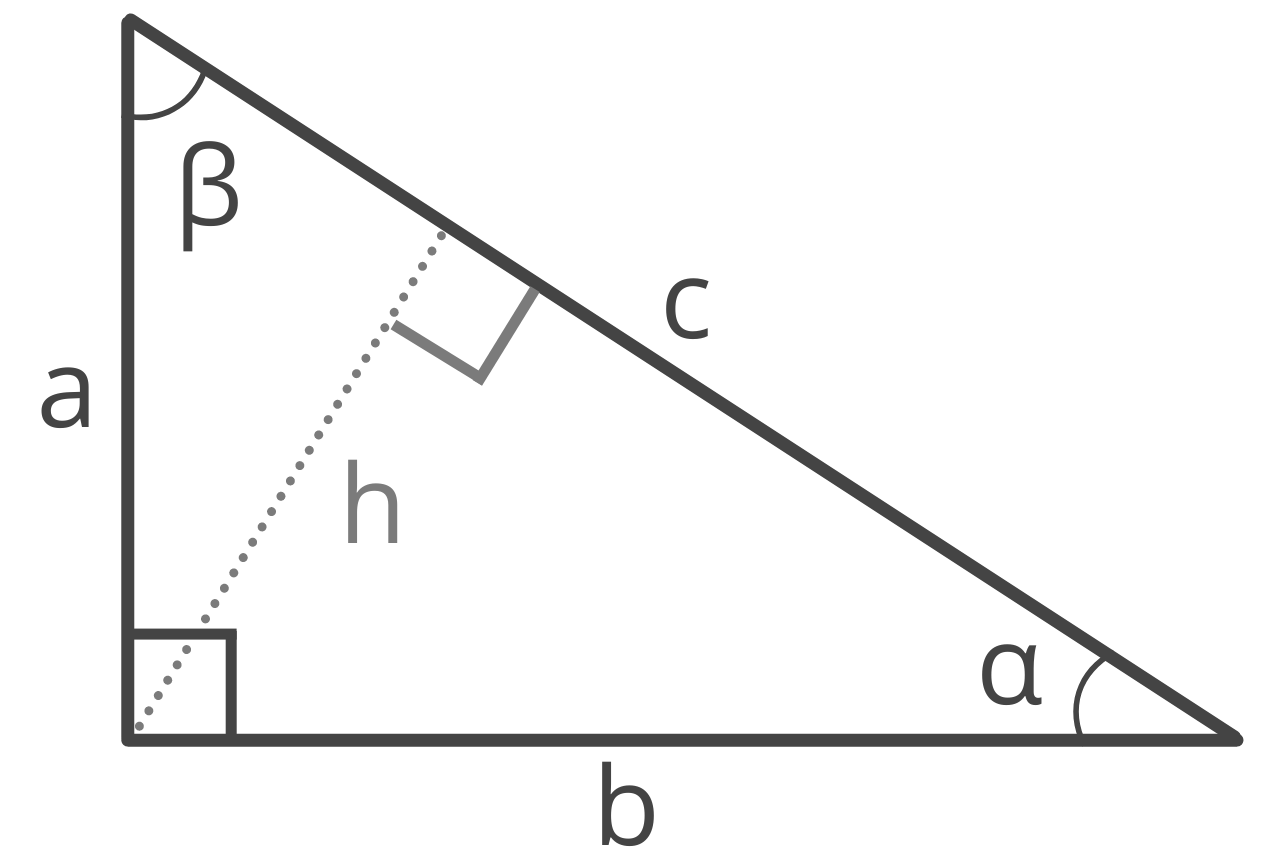
Side A sits opposite Angle α, Side B opposite Angle β, and the third angle is the 90° right angle.
What makes a right triangle solvable
A right triangle is unusually easy to pin down, because it comes with that fixed 90° corner already built in. Two facts then do the heavy lifting. The Pythagorean theorem, a² + b² = c², links the three sides. And the trig ratios, SOH-CAH-TOA, link the sides to the two acute angles. From almost any two pieces of information, everything else follows.
The eight properties it juggles
The tool keeps track of eight quantities at once: the two legs (Side A and Side B), the hypotenuse, the two acute angles (α and β, which always add up to 90°), the height (the altitude drawn to the hypotenuse), the area, and the perimeter. Hand it any two of these and it finds the other six.
Two combinations that will not work
A couple of pairings simply do not carry enough information. Two angles on their own will not do it, because the angles fix the triangle's shape but not its size, you could scale it up or down and the angles would not change. The perimeter together with only the height also falls short, as it cannot separate the sides on its own. The tool tells you when a pairing is not enough rather than inventing an answer.
A worked example | sides 3 and 4
Enter Side A = 3 and Side B = 4.
- Pythagoras gives the hypotenuse: √(9 + 16) = 5.
- The angles come out to α ≈ 36.87° and β ≈ 53.13°.
- The height is 2.4, the area is 6, and the perimeter is 12.
That is the whole 3-4-5 triangle, filled in from just two sides.
Related tools
For the trig functions of a single angle, or a lighter two-value solve, see the trigonometry calculator. For a general triangle without a right angle, the triangle angle calculator. And for just a side by the theorem alone, the Pythagorean theorem calculator.
Questions people ask
What does this calculator solve?
Every property of a right triangle, the sides, angles, height, area, and perimeter, from any two you provide.
How many values do I need?
Two. From any two of the eight properties, the rest can be found.
Why will two angles alone not work?
Because angles set the shape but not the size. A triangle can be scaled up or down with the same angles.
What properties does it cover?
The two legs, the hypotenuse, the two acute angles, the height, the area, and the perimeter.
References
A note on the idea behind it. A right triangle is solved from two known properties using the Pythagorean theorem for the sides and the trigonometric ratios for the angles. Two angles alone cannot fix the size, and the perimeter with only the height does not determine the triangle. For further reading, see Right triangle.
- Solving a right triangle, using the Pythagorean theorem and the trigonometric ratios from any two known properties.

Okan Atalay is a results driven senior operations manager and a graduate of Industrial Engineering from Bilkent University. With over 22 years of experience in textile manufacturing and integrated operations, he has led large scale business process improvements and strategic planning initiatives. Currently, he serves as a top mathematics expert for a global ed tech platform, where he applies his analytical expertise to solve complex mathematical problems. At Eon Tools, he reviews converter and maths tools.
Other Tools
- 30 60 90 Triangle Calculator
- Arccos Calculator
- Arccot Calculator
- Arcsin Calculator
- Arctan Calculator
- Cosine Calculator
- Cotangent Calculator
- Hypotenuse Calculator
- Law Of Cosines Calculator
- Law Of Sines Calculator
- Pythagorean Theorem Calculator
- Secant Calculator
- Sine Calculator
- Tangent Calculator
- Trigonometry Calculator