
Perimeter Of Triangle Calculator
Add the three sides to get a triangle perimeter. Enter side lengths and see the total, helpful for geometry, fencing, and outlines.
Enter the Details
Result will appear here...
What this calculator does
The perimeter of a triangle is the distance around it, the three sides added together. Simple enough when you know all three. But often you do not: you might have two sides and an angle, or two angles and a side. This tool covers those cases too, working out the missing sides first and then adding.
All measurements here are in centimetres, with angles in degrees, and the perimeter comes back in centimetres.
Using the calculator
- Pick a calculation method to match what you know. The input boxes change with it.
- Type your side lengths (in cm) and any angles (in degrees).
- Press Calculate.
The result is the total distance around the triangle, rounded to two decimal places.
The four methods, and what each needs
The dropdown offers four ways in, named by what you already know. S is a side, A is an angle.
- SSS, three sides: all three side lengths. The perimeter is simply their sum.
- SAS, two sides and the angle between them: the third side is worked out first, then all three are added.
- ASA, two angles and the side between them: the two missing sides are worked out first, then added to the one you gave.
- AAS, two angles and a side not between them: same idea, the missing sides are found and added.
Rebuilding the sides you do not have
Here is the thing worth understanding: the perimeter is always just the three sides added together. The only reason the other methods exist is that you might not have been handed all three. So before adding, the tool rebuilds the ones you are missing, using two standard results of trigonometry.
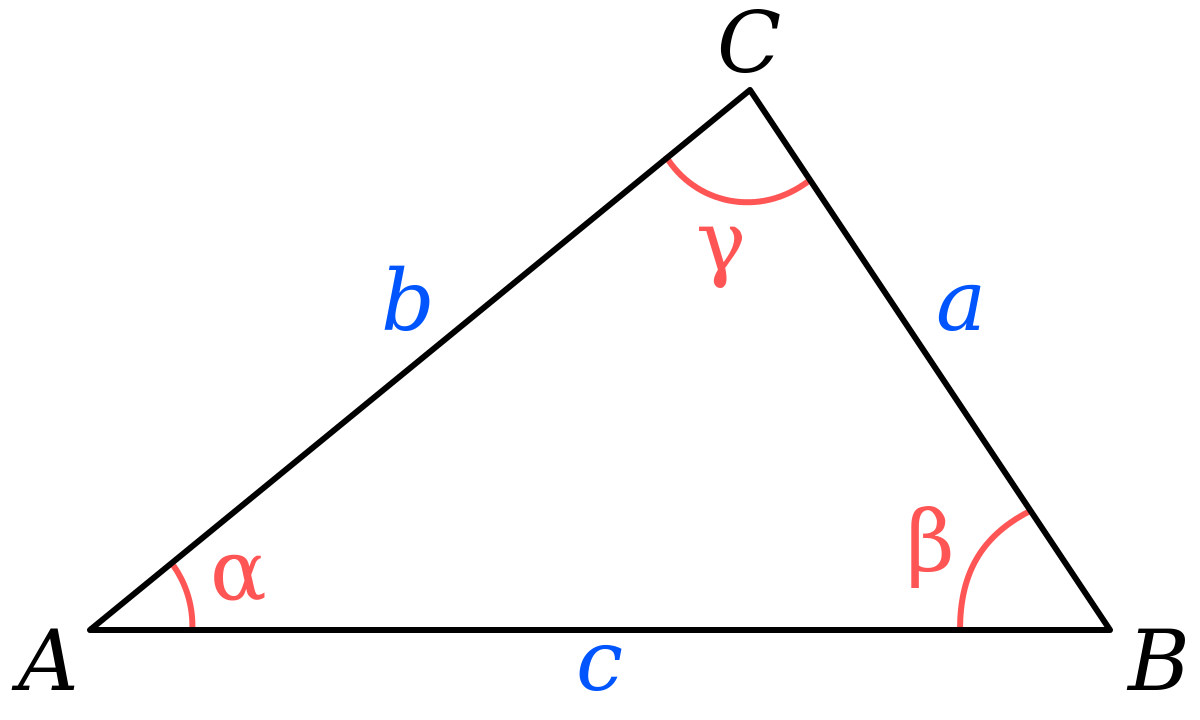
For SAS, where you have two sides and the angle wedged between them, it finds the third side with the law of cosines:
third side = √(a² + b² - 2 × a × b × cos(C))
where a and b are the two known sides and C is the angle between them. For ASA and AAS, where you have two angles and one side, it first finds the third angle (the three always add to 180 degrees), then uses the law of sines to get the missing sides: each side divided by the sine of its opposite angle gives the same value, so a missing side is the known side scaled by the ratio of the two sines. Once the three sides are in hand, every method finishes the same way, by adding them up.
Units, validity, and rounding
This tool works in centimetres throughout, both the sides you enter and the perimeter it returns, with angles given in degrees. The answer is rounded to two decimal places.
One thing to keep in mind when you enter three sides directly: for them to actually form a triangle, each pair has to add up to more than the third side. That is the triangle inequality. Three lengths like 1, 2 and 10 can be added, but they could never close into a triangle, so an answer there would not mean much.
Worked examples | adding sides, and the law of cosines
Two methods, side by side.
- SSS, sides 3, 4 and 5: just add them, 3 + 4 + 5 = 12.00 cm.
- SAS, sides 6 and 8 with a 90 degree angle between them: the third side is √(6² + 8² - 2 × 6 × 8 × cos(90°)) = √(36 + 64 - 0) = √100 = 10, so the perimeter is 6 + 8 + 10 = 24.00 cm.
That second one is the classic 6-8-10 right triangle. Because the angle was 90 degrees and the cosine of 90 degrees is zero, the law of cosines quietly turned into the Pythagorean theorem.
Questions people ask
What is the perimeter of a 3, 4, 5 triangle?
It is 12 cm. With all three sides known, the perimeter is just their sum: 3 + 4 + 5.
Do I just add the three sides?
Yes, when you know all three. That is the SSS method. The perimeter of any triangle is the sum of its sides.
What if I only have two sides and the angle between them?
Use SAS. The tool finds the third side with the law of cosines, then adds all three.
What if I have two angles and a side?
Use ASA or AAS. The tool finds the third angle, works out the missing sides with the law of sines, then adds them up.
What units does it use?
Centimetres for the sides and the perimeter, and degrees for the angles.
References
A note on where these come from. When some sides are unknown, the tool rebuilds them with two standard results of plane trigonometry: the law of cosines, which gives the third side from two sides and the angle between them, and the law of sines, which relates each side to the sine of its opposite angle. With all three sides known, the perimeter is just their sum. For further reading, see Perimeter.
- The law of cosines, c² = a² + b² - 2ab × cos(C), used to find the third side in the SAS case.
- The law of sines, relating each side of a triangle to the sine of its opposite angle, used to find the missing sides in the ASA and AAS cases.

Okan Atalay is a results driven senior operations manager and a graduate of Industrial Engineering from Bilkent University. With over 22 years of experience in textile manufacturing and integrated operations, he has led large scale business process improvements and strategic planning initiatives. Currently, he serves as a top mathematics expert for a global ed tech platform, where he applies his analytical expertise to solve complex mathematical problems. At Eon Tools, he reviews converter and maths tools.