
30 60 90 Triangle Calculator
Solve a 30-60-90 right triangle: enter any one side and get the other two sides using the 1 √3 2 ratio plus decimals.
Enter the Details
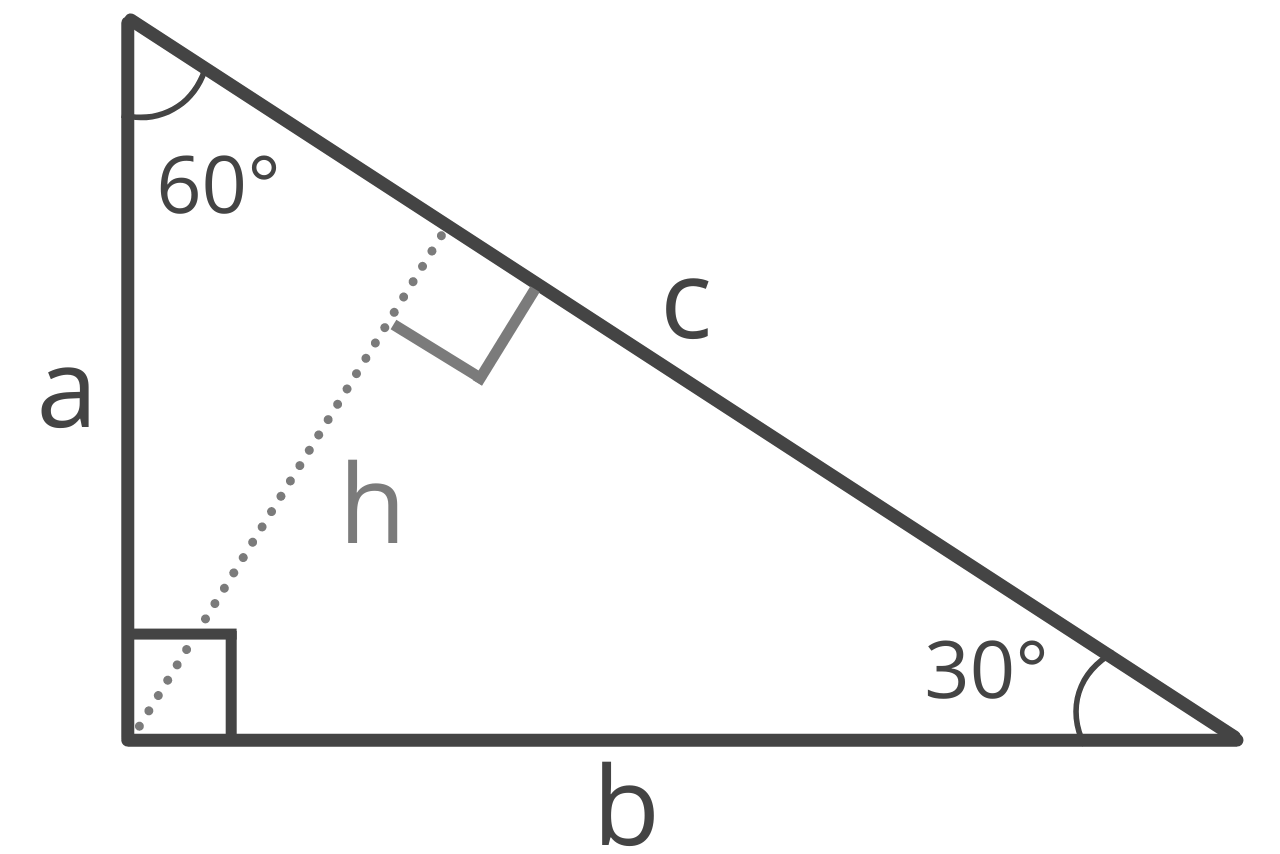
Result will appear here...
What this calculator does
So, you are working with a 30-60-90 triangle, the right triangle whose angles are 30, 60, and 90 degrees, and you know just one measurement of it. This tool takes that one value and works out everything else: all three sides, the height, the perimeter, the area, and even the inner and outer circle radii.
You pick which measurement you are supplying from a dropdown, enter its value, and press Calculate.
How to use it
- Choose what you know: hypotenuse, short leg, long leg, height, perimeter, or area.
- Enter that one value.
- Press Calculate to see the full set of measurements.
Why one value is enough
With most triangles you need several measurements before the shape is fixed. The 30-60-90 is different. Because all three of its angles are locked in, its shape never changes: every 30-60-90 triangle is just a scaled up or scaled down copy of every other. That means a single length, or the area, or the perimeter, sets the scale, and once the scale is known, every other measurement follows automatically. This is the whole appeal of the tool, and of the triangle: one number in, the complete triangle out.
The 1 to root 3 to 2 ratio
The engine behind it is a fixed ratio between the sides. In a 30-60-90 triangle, the short leg, the long leg, and the hypotenuse are always in the ratio 1 to root 3 to 2. In plain terms: the hypotenuse is exactly twice the short leg, and the long leg is the short leg times the square root of 3. The tool uses these relationships in whichever direction it needs. Tell it the hypotenuse and it halves it for the short leg; tell it the long leg and it works back through root 3; tell it the area or perimeter and it unwinds the ratio to recover a side first, then the rest.
Where the ratio comes from
The ratio is not arbitrary. Take an equilateral triangle, all sides equal, all angles 60 degrees, and slice it straight down the middle. Each half is a 30-60-90 triangle. That cut halves one side, giving the short leg as half the original, keeps a full side as the hypotenuse, so the hypotenuse is twice the short leg, and the height of the equilateral triangle becomes the long leg, which works out to the short leg times root 3. That is exactly the 1 to root 3 to 2 pattern, and it is why these particular numbers show up every time.
What it gives back
From your single input the tool reports the hypotenuse, the short leg opposite the 30 degree angle, the long leg opposite the 60 degree angle, the height, the perimeter, and the area. It also gives the inradius, the radius of the largest circle that fits inside, and the circumradius, the radius of the circle through all three corners, which for any right triangle is simply half the hypotenuse. All values are rounded to two decimal places.
A worked example
Say the hypotenuse is 10. The short leg is half of that, 5. The long leg is 5 times root 3, about 8.66. The perimeter is 10 plus 5 plus 8.66, about 23.66, and the area is half the short leg times the long leg, about 21.65. The circumradius is half the hypotenuse, 5. Every figure traces back to that one entered value of 10.
Questions people ask
Why do I only need to enter one value?
Because the 30-60-90 triangle has a fixed shape. One measurement sets its scale, and all the others follow from the fixed side ratio.
What is the side ratio?
Short leg to long leg to hypotenuse is 1 to root 3 to 2. The hypotenuse is twice the short leg, and the long leg is the short leg times root 3.
Where does that ratio come from?
From cutting an equilateral triangle in half. Each half is a 30-60-90 triangle, which produces exactly the 1 to root 3 to 2 sides.
Why is the circumradius half the hypotenuse?
For any right triangle, the hypotenuse is a diameter of the circle through its three corners, so the radius is half the hypotenuse.
How does it relate to the Pythagorean tool?
Both deal with right triangles. The Pythagorean theorem calculator needs two sides for any right triangle, while this one needs just one because the shape is fixed.
References
On the 30-60-90 triangle. Its sides are always in the ratio 1 to root 3 to 2, and its 30, 60, and 90 degree angles are among the special angles with exact trigonometric values.
- "Angles and Rotation," Mathematics LibreTexts, on the sides of a 30-60-90 triangle being in the ratio 1 to root 3 to 2.
- Eric W. Weisstein, "Trigonometry," from MathWorld, a Wolfram resource, on right-triangle side ratios and the special angles.

Okan Atalay is a results driven senior operations manager and a graduate of Industrial Engineering from Bilkent University. With over 22 years of experience in textile manufacturing and integrated operations, he has led large scale business process improvements and strategic planning initiatives. Currently, he serves as a top mathematics expert for a global ed tech platform, where he applies his analytical expertise to solve complex mathematical problems. At Eon Tools, he reviews converter and maths tools.
Other Tools
- Arccos Calculator
- Arccot Calculator
- Arcsin Calculator
- Arctan Calculator
- Cosine Calculator
- Cotangent Calculator
- Hypotenuse Calculator
- Law Of Cosines Calculator
- Law Of Sines Calculator
- Pythagorean Theorem Calculator
- Right Triangle Calculator
- Secant Calculator
- Sine Calculator
- Tangent Calculator
- Trigonometry Calculator